
Startup resources provide crucial support for new entrepreneurs launching businesses. The right resource selection can significantly accelerate your entrepreneurial journey. This guide compiles the most valuable tools, programs, and support systems available. You will discover resources for funding, education, mentorship, and operational needs. Every startup founder should leverage these assets to maximize success probability. Proper resource utilization separates thriving businesses from struggling ventures.
Last updated September 2025 • Reading time 15 min
Quick Overview: Essential Startup Resources
| Resource Category | Best For | Top Recommendations | Cost Range |
|---|---|---|---|
| Education Platforms | Knowledge building | Coursera, Udacity, Y Combinator Startup School | Free – $500 |
| Funding Resources | Capital acquisition | Grants.gov, AngelList, SeedInvest | Free – Equity |
| Business Tools | Operational efficiency | Slack, Trello, Google Workspace | Free – $30/user/month |
| Mentorship Programs | Guidance & networking | SCORE, MicroMentor, Founder Institute | Free – $5,000 |
| Government Resources | Compliance & support | SBA, BusinessUSA, Export.gov | Free |
| Community Platforms | Networking & support | Startup Grind, Meetup, LinkedIn Groups | Free – $300/year |
Why Startup Resources Matter for New Entrepreneurs
Startup resources dramatically improve entrepreneurial success rates. Approximately 20% of new businesses fail during their first two years . Access to proper resources reduces this failure risk significantly. The right tools and support help entrepreneurs avoid common pitfalls. They provide guidance, funding, and operational capabilities otherwise unavailable .
Resource selection should match your startup’s specific stage and needs. Pre-launch startups require different resources than growth-stage companies. Understanding available options prevents wasted time and resources. Strategic resource utilization accelerates progress toward key milestones. This efficiency proves particularly valuable for bootstrapped startups .
Global entrepreneurship continues growing at unprecedented rates. Over 100 million startups launch annually worldwide . This growth creates both opportunity and competition. Leveraging available resources provides competitive advantages. Smart entrepreneurs use every available tool to maximize their success probability .

Educational Resources for Startup Founders
Online Learning Platforms
Online education platforms offer affordable entrepreneurship education. Coursera provides business courses from top universities like Wharton and Stanford. Their entrepreneurship specialization covers opportunity analysis and business planning . Udacity offers nanodegree programs in technology entrepreneurship. These programs include mentor support and project-based learning .
edX features entrepreneurship courses from Harvard, MIT, and other institutions. Many courses are free with paid certification options. LinkedIn Learning offers practical business courses with professional certificates. Their content covers specific skills like financial modeling and marketing strategy .
Y Combinator Startup School remains free and highly valuable for early-stage founders. The program includes lectures, resources, and community support. Khan Academy provides free business and economics courses. Their content is particularly valuable for financial education basics .
University Entrepreneurship Programs
Many universities offer entrepreneurship programs and resources. Stanford Online delivers entrepreneurship and innovation courses. Their programs combine academic rigor with Silicon Valley insights. Harvard Business School Online offers CORe (Credential of Readiness) program. This covers business fundamentals through case-based learning .
MIT OpenCourseWare provides free access to actual course materials. Their entrepreneurship courses include lectures, notes, and assignments. Babson College offers online entrepreneurship programs ranked among the best globally. Their approach emphasizes entrepreneurial thinking and action .
Local university programs often provide valuable resources too. Many business schools offer entrepreneurship centers and incubators. These provide mentoring, networking, and sometimes funding opportunities. Community college programs offer affordable business education options .
Specialized Training Programs
Industry-specific programs address particular entrepreneurial needs. General Assembly offers workshops and courses on digital business skills. Their programs cover topics like digital marketing and product management. Techstars provides community-based entrepreneurship programs. These combine education with mentorship and networking .
Founder Institute offers structured pre-seed startup programs. Their four-month program includes curriculum, mentoring, and potential funding. Startup Grind offers educational events and global conferences. These provide learning and networking opportunities simultaneously.
Corporate accelerator programs provide industry-specific education. Companies like Google, Microsoft, and Amazon offer startup programs. These provide technical training, cloud credits, and business guidance. Industry associations often offer specialized entrepreneurial training too.
Funding Resources for Startups
Grant Opportunities
Government grants provide non-dilutive funding for qualified startups. Grants.gov lists all available federal grant opportunities. Many target specific industries, technologies, or demographic groups . SBIR/STTR programs offer grants for technology research and development. These programs provide significant funding without equity sacrifice .
State and local grants support regional economic development. Most states maintain business grant programs for local startups. Corporate grant programs offer funding through CSR initiatives. Companies like FedEx, Visa, and MillerCoors offer startup grants annually .
Foundation grants support social entrepreneurship ventures. The Bill & Melinda Gates Foundation funds health and development startups. The Ford Foundation supports social justice entrepreneurship. Numerous smaller foundations offer niche-specific grant opportunities .
Equity Funding Platforms
AngelList revolutionized startup fundraising through online platforms. It connects startups with angel investors and venture capitalists. The platform also facilitates syndicate investments and job recruitment . SeedInvest provides equity crowdfunding for early-stage companies. They vet all startups before listing on their platform .
Republic allows everyday investors to fund startups through regulation crowdfunding. Their platform supports both equity and crypto-based fundraising. StartEngine has helped raise over $500 million for startups. They offer both regulation crowdfunding and regulation A+ offerings .
Venture capital databases help identify potential investors. Crunchbase and PitchBook provide comprehensive investor databases. These platforms offer investor information, funding histories, and contact details. Gust connects startups with angel investor groups globally.
Debt Financing Options
SBA loans offer favorable terms for qualified small businesses. The 7(a) loan program provides general business financing. The 504 loan program supports real estate and equipment purchases. Microloan programs offer smaller loans under $50,000 .
Online lenders provide faster financing alternatives. Kabbage and OnDeck offer lines of credit and term loans. Funding Circle focuses on small business term loans. These options typically have higher rates but faster approval processes.
Revenue-based financing offers alternative debt structures. Lighter Capital and Earnest Capital provide revenue-based loans. These align repayment with business performance. Credit lines from traditional banks provide flexible funding options.

Essential Business Tools for Startups
Communication and Collaboration Tools
Slack remains the dominant team communication platform for startups. It offers channel-based messaging, file sharing, and integration capabilities. The free tier supports most early-stage needs adequately . Microsoft Teams provides similar functionality within the Office 365 ecosystem. It works particularly well for organizations already using Microsoft products.
Zoom dominates video conferencing for remote teams. Their free tier supports 40-minute meetings with multiple participants. Google Meet offers competitive video conferencing within Google Workspace. Both platforms provide reliable video communication essential for remote teams.
Notion combines documentation, project management, and knowledge bases. Its flexibility makes it valuable for evolving startup needs. Confluence provides more structured documentation capabilities. It integrates well with other Atlassian products like Jira.
Project Management Tools
Trello offers simple, visual project management using Kanban boards. Its intuitive interface makes it accessible for non-technical teams. The free version supports basic project management needs effectively . Asana provides more robust project management capabilities. It supports task dependencies, timelines, and advanced reporting.
Jira dominates software development project management. It supports agile methodologies like Scrum and Kanban effectively. Monday.com offers visual project management with extensive customization. Its flexibility suits various team types and workflows.
Basecamp provides all-in-one project management and communication. It combines messaging, task management, and document storage. Their flat pricing structure makes budgeting predictable for growing teams.
Marketing and Sales Tools
HubSpot offers free CRM and marketing tools for startups. Their free tier includes contact management, email marketing, and live chat. Mailchimp provides email marketing services with generous free tiers. Their platform supports automation, segmentation, and analytics.
Canva enables professional graphic design without expertise. Their free version offers templates for social media, presentations, and marketing materials. Hootsuite manages social media accounts from a single dashboard. Their free plan supports limited social profiles and scheduling.
Google Analytics provides essential website traffic insights. The free version meets most startup analytics needs effectively. Hotjar offers heatmaps and user session recordings. These insights help optimize website conversion rates.
Mentorship and Advisory Resources
Formal Mentorship Programs
SCORE provides free business mentoring from experienced executives. Their volunteer mentors offer guidance across business domains. They provide both local and remote mentoring options . MicroMentor connects entrepreneurs with business mentors online. Their platform facilitates mentorship relationships across industries.
Founder Institute includes mentorship as part of their program curriculum. Their mentors are successful entrepreneurs and investors. Techstars and Y Combinator provide intensive mentorship during their programs. These programs offer access to high-quality mentor networks.
Industry-specific mentorship programs address particular domain needs. DigitalOcean offers mentorship for technical founders. Shopify provides mentoring for e-commerce entrepreneurs. Many industry associations offer mentorship programs for members.
Advisory Board Development
Formal advisory boards provide structured guidance for startups. Advisors typically receive equity compensation for their contributions. The Advisory Board offers guidance on forming effective boards. They provide templates for advisor agreements and compensation structures.
Angel investors often provide advisory support alongside funding. Their experience and networks can significantly accelerate growth. Professional advisor networks connect startups with experienced advisors. These platforms facilitate advisor matching based on specific needs.
University entrepreneurship programs often provide access to advisors. Many business schools have executive-in-residence programs. These connect startups with experienced business leaders. Local economic development organizations often offer advisory services too.
Peer Mentoring Groups
Entrepreneurial peer groups provide valuable support and accountability. EO (Entrepreneurs’ Organization) offers peer mentoring for established entrepreneurs. YPO provides peer networking for young presidents and executives. Both organizations require significant revenue thresholds for membership.
Startup-specific peer groups cater to earlier stage entrepreneurs. Startup Grind hosts local events and peer discussions. Meetup offers numerous entrepreneurial networking groups. Many cities have informal startup founder gatherings.
Mastermind groups provide structured peer mentoring. These small groups meet regularly to discuss challenges and opportunities. They provide accountability, feedback, and support. Many entrepreneurs form mastermind groups with complementary skills.
Government and Legal Resources

Business Registration and Compliance
The U.S. Small Business Administration (SBA) provides comprehensive startup resources. Their website offers guides on business planning, registration, and financing. They provide local assistance through SBA district offices . BusinessUSA serves as a centralized resource for government business information. It simplifies access to federal, state, and local resources.
State business portals provide specific registration requirements. Every state maintains a business registration website. These sites outline incorporation procedures, fees, and ongoing requirements. Local city and county offices provide additional business licensing information.
LegalZoom and Rocket Lawyer offer affordable legal document services. They provide business formation documents, contracts, and compliance materials. These services reduce legal costs for early-stage startups.
Intellectual Property Protection
The USPTO (United States Patent and Trademark Office) provides trademark and patent resources. Their website offers guidance on intellectual property protection. They provide search tools for existing patents and trademarks . Copyright.gov offers information on copyright registration and protection.
Pro bono legal services assist startups with limited resources. Lawyers for the Creative Arts helps creative industry startups. Patent Pro Bono Program assists with patent applications. Many law schools offer legal clinics for entrepreneurs.
IP accelerator programs help startups protect intellectual property. These programs provide discounted legal services and guidance. Some regional economic development organizations offer IP support grants.
Export and International Trade Resources
Export.gov provides resources for startups exploring international markets. Their services include market research, trade events, and export financing information. The U.S. Commercial Service offers customized international market entry support. Their services include partner identification and market assessment.
SBA export loan programs support international business expansion. Their Export Working Capital Program helps finance export orders. The International Trade Loan Program supports equipment and facility needs for exporting.
State international trade offices assist with global expansion. Most states maintain international trade representatives. These offices provide market information and connection services. Many participate in international trade missions and events.
Community and Networking Resources
Online Community Platforms
LinkedIn Groups provide professional networking opportunities. Numerous groups cater to specific industries and entrepreneurial topics. Facebook Groups offer more informal community interactions. Many cities have local entrepreneur groups on Facebook.
Reddit communities like r/entrepreneur and r/startups provide discussion forums. These platforms offer advice, feedback, and resource sharing. Quora features entrepreneurial questions and expert answers. These platforms provide valuable insights from experienced founders.
Industry-specific forums cater to particular business types. Stack Overflow serves technical entrepreneurs and developers. Warrior Forum focuses on internet marketing discussions. Indie Hackers supports bootstrapped software entrepreneurs.
Event and Conference Resources
Meetup lists local entrepreneurial events and networking gatherings. Most cities have regular startup events and pitch competitions. Eventbrite features entrepreneurial conferences and workshops. Their platform allows filtering by location and topic.
TechCrunch Disrupt represents a major startup conference series. It features startup competitions, speaker sessions, and networking. Web Summit attracts global startups and investors annually. SXSW includes extensive startup and innovation programming.
Industry-specific conferences cater to particular sectors. These events provide networking, education, and exposure opportunities. Many offer startup discounts or competition entries for visibility.
Coworking and Incubator Spaces
WeWork provides flexible coworking spaces globally. Their locations offer networking events and community benefits. Regus offers professional office spaces with flexible terms. Both providers have multiple location options in major cities.
Local incubators provide workspace with additional support services. Many universities operate startup incubators with mentoring programs. Economic development incubators often offer subsidized space and services.
Industry-specific incubators cater to particular sectors. BioLabs provides laboratory space for life science startups. Food incubators support food and beverage entrepreneurs. Tech incubators offer technical resources and mentoring.
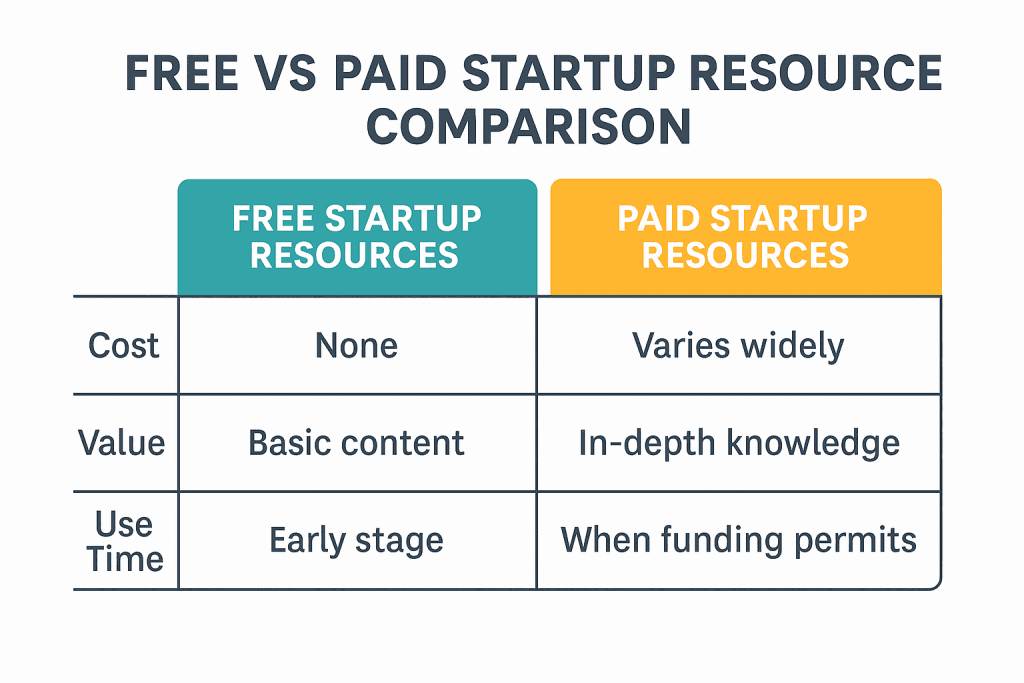
Comparison Table: Startup Resource Types
| Resource Type | Best For | Cost Range | Time Commitment | Support Level |
|---|---|---|---|---|
| Online Courses | Knowledge building | Free – $500 | Self-paced | Low |
| Accelerators | Intensive growth | Equity – $10,000 | 3-6 months | High |
| Coworking Spaces | Networking & space | $100-$500/month | Ongoing | Medium |
| Mentorship Programs | Guidance & advice | Free – Equity | Regular meetings | High |
| Grant Programs | Non-dilutive funding | Free | Application process | Low |
| Business Tools | Operational efficiency | Free – $50/user/month | Ongoing | Low |
How to Select the Right Resources: Step-by-Step Guide
Step 1: Assess Your Current Needs
Identify your most pressing challenges and knowledge gaps. Evaluate your team’s existing skills and experience. Determine what resources would provide the greatest immediate impact. Prioritize needs based on your current development stage .
Step 2: Research Available Options
Explore multiple resource options for each need category. Compare features, costs, and time requirements. Read reviews and testimonials from other startups. Seek recommendations from trusted entrepreneurial networks .
Step 3: Evaluate Resource Quality
Assess the credibility and reputation of resource providers. Check their track record with similar startups. Verify the expertise and experience of mentors or instructors. Review success metrics and outcomes for previous participants .
Step 4: Consider Implementation Requirements
Evaluate the time and effort required for each resource. Ensure your team has capacity to utilize resources effectively. Consider integration requirements with existing systems and processes. Assess learning curves and training needs .
Step 5: Plan Resource Integration
Develop an implementation plan for selected resources. Assign responsibility for managing each resource relationship. Set specific goals and metrics for resource utilization. Schedule regular reviews of resource effectiveness .
Step 6: Allocate Budget Appropriately
Determine realistic budget allocations for each resource category. Balance free and paid resources based on value and urgency. Consider opportunity costs of time investments. Plan for resource scaling as your startup grows .
Step 7: Establish Feedback Mechanisms
Create systems to evaluate resource effectiveness regularly. Gather team feedback on resource utility and impact. Track ROI for paid resources through performance metrics. Be prepared to adjust or replace underperforming resources .
Frequently Asked Questions (FAQ)
What are the most important resources for early-stage startups?
Essential early-stage resources include mentorship, basic business tools, and educational materials. The SBA provides excellent free resources for business planning and registration. Free tool tiers from providers like Google, Slack, and Trello meet most initial needs. Mentorship from organizations like SCORE provides valuable guidance .
How much should startups budget for resources and tools?
Early-stage startups should minimize costs through free resources initially. Allocate 5-10% of your budget for essential paid tools and services. Focus spending on resources that directly impact revenue or efficiency. As you grow, increase resource investment based on demonstrated ROI .
Are startup accelerators worth the equity they require?
Accelerators provide valuable resources but require careful evaluation. Top programs like Y Combinator and Techstars offer exceptional value through mentorship, funding, and networks. Weaker programs may not justify their equity requirements. Research outcomes for previous participants before committing .
How do I find local startup resources in my area?
Local resources are available through multiple channels. Check with your local SBA district office and Small Business Development Center. Search Meetup and Eventbrite for local entrepreneurial events. Contact local universities and economic development organizations. Join regional entrepreneur groups on LinkedIn and Facebook .
What free resources are available for bootstrapped startups?
Numerous free resources support bootstrapped startups effectively. Educational platforms like Coursera and edX offer free courses. Google Workspace provides essential business tools for free initially. SCORE and MicroMentor offer free business mentoring. Grants.gov lists non-dilutive funding opportunities .
How do I evaluate the quality of startup resources?
Evaluate resources based on provider reputation, user reviews, and outcomes. Check the credentials and experience of mentors or instructors. Request case studies or success metrics from resource providers. Seek recommendations from trusted entrepreneurial networks. Test free trials before committing to paid options .
When should startups invest in paid resources versus free options?
Upgrade to paid resources when free options limit growth or efficiency. Invest in tools that save significant time or increase revenue. Consider paid resources when they provide competitive advantages. Upgrade educational resources when they address specific skill gaps affecting performance .
Key Takeaways: Startup Resource Success
- Leverage free resources first – Maximize free tools and programs before investing in paid options
- Match resources to your stage – Choose resources appropriate for your current development phase
- Focus on highest impact areas – Prioritize resources that address your most critical needs
- Network strategically – Build relationships with mentors, peers, and service providers
- Measure resource effectiveness – Regularly evaluate ROI from time and money investments
- Remain adaptable – Adjust resource allocation as your startup evolves and grows
Conclusion: Building Your Resource Ecosystem
Startup resources provide essential support for entrepreneurial success. The right resource selection accelerates progress and reduces failure risk. This guide has highlighted valuable options across multiple categories. Every startup should strategically leverage available resources.
Begin with free resources to minimize initial costs. Focus on education, basic tools, and mentorship initially. Gradually invest in paid resources as you demonstrate needs and capacity. Always evaluate resource effectiveness through measurable outcomes.
Remember that resources are means to ends rather than ends themselves. Choose resources that directly support your business goals. Continuously assess whether resources provide value exceeding their costs. The most successful entrepreneurs leverage resources strategically rather than accumulating them indiscriminately.
Author’s Note: As a serial entrepreneur and startup advisor, I’ve tested hundreds of startup resources firsthand. My recommendations are based on practical experience with what actually delivers value to early-stage companies. The right resources at the right time can significantly accelerate your entrepreneurial journey.
Reviewed by: Startup Advisory Board
Recommended Reads & Tools
- “The Lean Startup” by Eric Ries – Methodology for developing businesses and products. Buy on Amazon
- “Zero to One” by Peter Thiel – Notes on startups, or how to build the future. Buy on Amazon
- “The Startup Owner’s Manual” by Steve Blank – Step-by-step guide for building a great company. Buy on Amazon
- Business Model Generation – Handbook for visionaries, game changers, and challengers. Buy on Amazon
- Startup Financial Model Template – Excel-based financial projection tool. Buy on Amazon
Further Learning
- Startup Resource Allocation Strategies – How to prioritize limited resources effectively (YouTube)
- Building Your Startup Support Network – Guide to mentors, advisors, and peer groups (YouTube)
Internal Linking Suggestions
- [How to Write a Startup Business Plan for Investors: 2025 Guide]
- [Best Startup Funding Options 2025: A Practical Guide for Founders]
- [Startup Funding Options in 2025: 6 Proven Ways to Finance Your Business]
- [How to Create Your First Budget: Complete Beginner’s Guide]
- [Startup Marketing on a Limited Budget: Strategies That Work]
External Resources
- [U.S. Small Business Administration Startup Resources]
- [Score.org Free Business Mentoring]
- [Grants.gov Federal Grant Opportunities]
- [U.S. Patent and Trademark Office]
- [BusinessUSA Government Resource Portal]


