
Writing a startup business plan for investors requires precision and persuasion. An effective plan demonstrates market understanding and growth potential. This guide provides the exact structure investors expect to see. You will learn how to write compelling financial projections and market analysis. The right approach can secure funding for your startup vision. A strong business plan communicates credibility and opportunity clearly.
Last updated September 2025 • Reading time 20 min
Quick Overview: Essential Business Plan Components
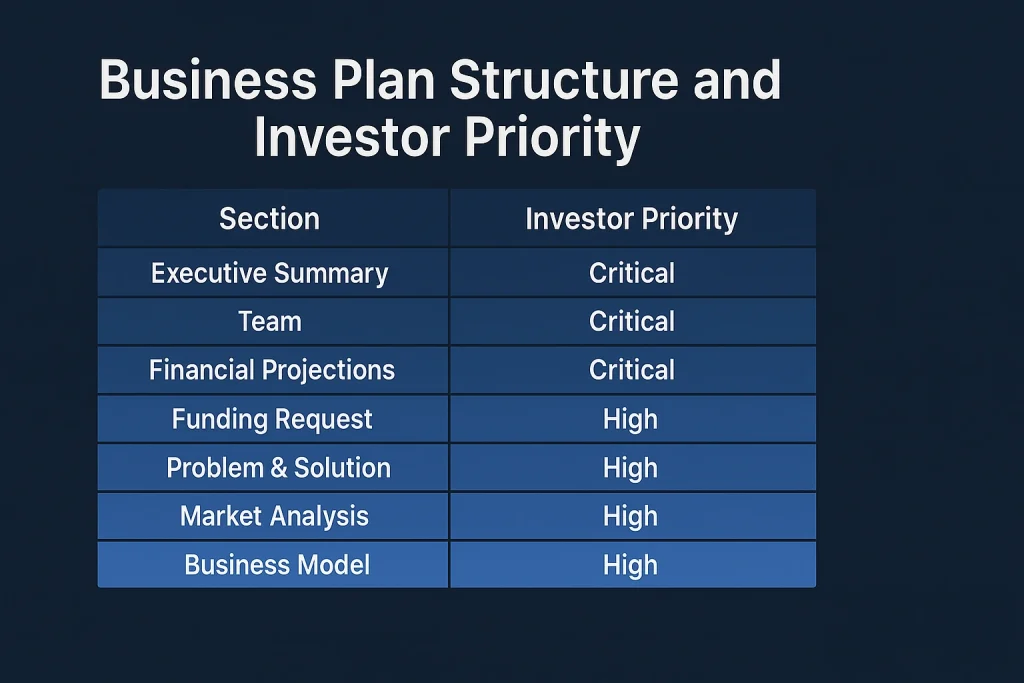
| Section | Importance | Investor Focus Areas |
|---|---|---|
| Executive Summary | Critical | Market opportunity, solution, traction |
| Problem & Solution | High | Pain point severity, solution effectiveness |
| Market Analysis | High | TAM/SAM/SOM, growth trends, competition |
| Business Model | High | Revenue streams, pricing, unit economics |
| Team | Critical | Experience, relevant expertise, gaps |
| Financial Projections | Critical | Realistic assumptions, growth metrics |
| Funding Request | Critical | Use of funds, milestones, valuation |
Why Investor-Focused Business Plans Matter
Investor business plans differ significantly from internal operational documents. They focus on return potential, scalability, and risk mitigation. Venture capitalists review hundreds of plans annually, spending only 3-4 minutes on each initially . Your plan must immediately capture attention and demonstrate understanding. A strong plan increases funding probability substantially .
Successful startup fundraising requires addressing investor concerns proactively. Investors seek teams that understand their market deeply. They want evidence of traction and realistic financial projections. Your plan must communicate competitive advantages clearly. It should demonstrate how funding will accelerate growth meaningfully .
The business plan serves as both marketing document and operational roadmap. It must balance vision with practical execution planning. Investors look for both ambitious thinking and grounded realism. The following structure addresses all critical investor requirements effectively .
Executive Summary: The Make-or-Break Section
Purpose and Positioning
The executive summary is the most critical section for investor attention. Many investors read only this section before deciding whether to continue . It must compellingly summarize your entire business in one page. This section should stand alone as a complete persuasive document.
Key Components
Include these essential elements in your executive summary:
- Company description: Name, location, legal structure, and founding date
- Problem statement: The specific pain point you’re addressing
- Solution description: Your product/service and how it solves the problem
- Market opportunity: Total Addressable Market (TAM) and target segment
- Traction achieved: Current milestones, customers, and revenue
- Competitive advantage: What makes your solution unique and defensible
- Team overview: Key team members and relevant experience
- Funding request: Amount needed and specific use of funds
- Financial highlights: Key projections and metrics
Writing Tips
Start with a powerful opening statement that captures immediate attention. Use data-driven market size information to establish opportunity scale. Highlight impressive traction metrics early to establish credibility. Keep language concise and avoid jargon unless clearly defined. End with a clear call to action for next steps .
Common Mistakes
Avoid these executive summary pitfalls:
- Exceeding one page in length
- Using vague or unsubstantiated claims
- Hiding the funding request amount
- Focusing on features rather than benefits
- Omitting team credentials and experience

Problem and Solution Analysis
Problem Statement Framework
Articulate the problem clearly and specifically from the customer perspective. Quantify the pain point using market research and data. Explain why current solutions are inadequate or expensive. Demonstrate the problem’s significance through economic impact calculations .
Use this structure for maximum impact:
- Who experiences the problem (target customer)
- What the problem is (specific pain point)
- How often it occurs (frequency and timing)
- Current alternatives (why they’re insufficient)
- Economic impact (cost of not solving the problem)
Solution Description
Present your solution as the obvious answer to the articulated problem. Focus on benefits rather than technical features. Explain how your solution specifically addresses pain points better than alternatives. Include evidence of solution validation through prototypes, testing, or early adoption .
Effective solution descriptions include:
- Key features and how they address specific pain points
- Development status (concept, MVP, launched, etc.)
- Unique technology or approach that provides advantage
- Pricing strategy and how it compares to alternatives
- Implementation process for customers
Validation Evidence
Provide proof that your solution effectively addresses the problem. Include:
- Customer testimonials or case studies
- Usage metrics from beta testing or early adoption
- Third-party validation from industry experts
- Awards or recognition received
- Patent filings or proprietary technology status
Market Analysis and Opportunity
Market Size Calculation
Investors require precise market size calculations using standard methodologies:
- TAM (Total Addressable Market): Total market demand annually
- SAM (Serviceable Available Market): Segment you can realistically serve
- SOM (Serviceable Obtainable Market): Share you can capture in 3-5 years
Use credible data sources for market calculations:
- Industry reports from Gartner, Forrester, or IBISWorld
- Government statistics and census data
- Academic research studies
- Analyst projections and market forecasts
Market Trends Analysis
Identify and explain relevant market trends that support your opportunity:
- Technological trends enabling your solution
- Regulatory changes creating opportunities
- Consumer behavior shifts driving adoption
- Economic factors influencing demand
- Industry disruptions creating openings
Target Customer Profile
Define your ideal customer with precise demographic and psychographic details:
- Demographics: Age, income, location, company size, etc.
- Psychographics: Values, preferences, buying motivations
- Behavioral patterns: How they currently solve the problem
- Purchase process: Decision makers and buying criteria
- Customer acquisition cost: How you will reach them
Competition Analysis
Provide a realistic assessment of current and potential competitors:
- Direct competitors: Offering similar solutions to same customers
- Indirect competitors: Solving the same problem differently
- Potential entrants: Companies that could easily enter your space
- Competitive advantages: Your sustainable differentiators
- Barriers to entry: What protects your market position
Business Model and Revenue Strategy
Revenue Model Design
Clearly articulate how you will generate revenue:
- Primary revenue streams: Main sources of income
- Pricing strategy: How you determine prices and structure
- Payment terms: How and when customers pay
- Sales cycles: Length and process from lead to close
- Customer lifetime value: Revenue per customer over relationship
Common Revenue Models
Choose the most appropriate model for your business:
- Subscription/membership: Recurring revenue model
- Transaction fees: Percentage of transaction value
- Licensing: Fees for using intellectual property
- Advertising: Revenue from third-party advertisers
- Data monetization: Selling aggregated insights
- Hybrid models: Combining multiple revenue streams
Unit Economics
Include detailed unit economics that demonstrate profitability potential:
- Customer Acquisition Cost (CAC): Cost to acquire one customer
- Lifetime Value (LTV): Total revenue from one customer
- LTV/CAC ratio: Should be 3:1 or higher for scalability
- Payback period: Time to recover customer acquisition costs
- Contribution margin: Revenue minus variable costs per unit
Sales and Distribution Strategy
Explain how you will reach customers and deliver your solution:
- Sales channels: Direct, partners, online, etc.
- Distribution methods: How customers access your solution
- Marketing approach: How you will generate awareness and leads
- Partnership strategy: Key alliances that accelerate growth
- Customer support: How you will maintain satisfaction
Marketing and Customer Acquisition
Go-to-Market Strategy
Detail your initial market entry approach:
- Target segments: Which customers you’ll pursue first
- Geographic focus: Where you’ll launch and expand
- Pricing strategy: Introductory offers and packages
- Launch timeline: Key milestones and activities
- Early adopter focus: How you’ll attract initial customers
Customer Acquisition Plan
Provide specific customer acquisition tactics with cost projections:
- Digital marketing: SEO, PPC, social media, content marketing
- Traditional marketing: Events, PR, direct mail, advertising
- Sales process: Inside sales, field sales, channel partners
- Virality and referrals: Natural growth mechanisms
- Strategic partnerships: Co-marketing and distribution deals
Marketing Budget and Metrics
Include detailed marketing budget with expected returns:
- Acquisition channels: Breakdown by method and cost
- Conversion rates: Expected lead to customer percentages
- Scalability assessment: Which channels can scale efficiently
- Testing plan: How you’ll optimize acquisition costs
- Key metrics: CAC, LTV, payback period, ROI

Management Team Section
Team Composition
Highlight key team members and their relevant experience:
- Founders: Background, expertise, and previous successes
- Management team: Experience and domain knowledge
- Advisors: Industry experts and their contributions
- Board members: Relevant experience and connections
- Key hires needed: Who you plan to recruit with funding
Team Credentials
Emphasize relevant experience that builds investor confidence:
- Industry experience: Years in your specific market
- Startup experience: Previous founding or early-stage roles
- Domain expertise: Technical or specialized knowledge
- Track record: Previous exits, successes, or achievements
- Education: Relevant degrees and certifications
Addressing Team Gaps
Be honest about team weaknesses and how you’ll address them:
- Skill gaps: Missing expertise and recruitment plans
- Advisor needs: Areas where guidance is required
- Board development: How you’ll strengthen governance
- Recruitment strategy: How you’ll attract top talent
- Retention plans: How you’ll keep key team members
Financial Projections and Assumptions
Projection Period and Detail
Provide 5-year financial projections with monthly detail for first two years:
- Income statements: Revenue, COGS, operating expenses, net income
- Balance sheets: Assets, liabilities, equity
- Cash flow statements: Operating, investing, financing activities
- Key metrics: CAC, LTV, burn rate, runway, growth rates
Assumption Documentation
Clearly state all assumptions behind your projections:
- Revenue assumptions: Growth rates, pricing, customer adoption
- Cost assumptions: Team size, salaries, marketing spend
- Market assumptions: Adoption rates, competitive response
- Economic assumptions: Macro factors affecting business
- Sensitivity analysis: How changes affect projections
Realistic Projections
Avoid overly optimistic projections that undermine credibility:
- Base case: Realistic achievable scenario
- Best case: Optimistic but possible outcomes
- Worst case: Conservative protection scenario
- Key milestones: Specific targets for each funding round
- Break-even analysis: When you expect to become profitable
Key Metrics Dashboard
Include the metrics investors care about most:
- Monthly Recurring Revenue (MRR): For subscription businesses
- Customer churn rate: Percentage of customers lost monthly
- Gross margin: Revenue minus direct costs
- Burn rate: Monthly cash consumption
- Runway: Months until cash exhaustion
- Growth rate: Month-over-month revenue increase

Funding Request and Use of Funds
Funding Amount Determination
Calculate exactly how much funding you need:
- Detailed budget: Itemized use of funds breakdown
- Runway extension: 18-24 months of operation funding
- Milestone funding: Amount needed to achieve next valuation inflection
- Contingency buffer: 10-15% for unexpected expenses
- Previous raises: Amounts raised to date and from whom
Use of Funds Allocation
Provide specific allocation percentages across categories:
- Product development: Engineering, design, testing
- Marketing and sales: Customer acquisition programs
- Team expansion: Key hires and recruitment costs
- Operating expenses: Rent, utilities, administrative costs
- Contingency fund: Unexpected opportunities or challenges
Milestone Timeline
Connect funding to specific achievable milestones:
- Product milestones: Feature releases, version updates
- Business milestones: Customer targets, revenue goals
- Team milestones: Key hires, organizational development
- Market milestones: Geographic expansion, new segments
- Financial milestones: Break-even, profitability targets
Valuation Justification
Provide rationale for your valuation request:
- Comparable analysis: Similar company valuations
- Revenue multiples: Industry standard valuation metrics
- Growth potential: Future revenue and profit projections
- Asset value: Intellectual property and technology worth
- Team value: Experience and execution capability
Risk Analysis and Mitigation
Risk Identification
Honestly address potential risks to your business:
- Market risks: Adoption challenges, competitive threats
- Technology risks: Development hurdles, scalability issues
- Team risks: Key person dependencies, recruitment challenges
- Financial risks: Cash flow constraints, funding availability
- Regulatory risks: Legal changes, compliance requirements
Mitigation Strategies
For each risk, provide specific mitigation plans:
- Preventative measures: How you’ll avoid the risk
- Contingency plans: How you’ll respond if risk occurs
- Insurance coverage: What risks are transferable
- Monitoring systems: How you’ll track risk indicators
- Alternative strategies: Backup plans if primary approach fails
Investor Risks
Address specific investor concerns:
- Exit potential: How investors will achieve returns
- Liquidity preferences: Investor protection mechanisms
- Dilution risk: How future rounds affect ownership
- Governance rights: Investor control and oversight
- Information rights: How you’ll communicate progress
Appendix and Supporting Documents
Essential Supporting Materials
Include these documents in your appendix:
- Detailed financial models: Excel spreadsheets with assumptions
- Market research data: Original research and third-party reports
- Product screenshots: Mockups, prototypes, or actual product images
- Team resumes: Detailed CVs for key team members
- Legal documents: Incorporation papers, patents, trademarks
- Customer contracts: Key agreements and partnerships
- Press coverage: Articles, reviews, and media mentions
Presentation Materials
Prepare these additional materials for investor meetings:
- Investor pitch deck: 10-15 slide presentation version
- Executive summary: Standalone one-page overview
- Financial summary: Key numbers and metrics handout
- Product demo: Live or recorded demonstration
- Team profiles: One-page bios of key team members
Comparison Table: Business Plan Components
| Section | Length | Detail Level | Investor Priority |
|---|---|---|---|
| Executive Summary | 1 page | High-level overview | Critical |
| Problem & Solution | 2-3 pages | Specific and detailed | High |
| Market Analysis | 3-5 pages | Data-driven analysis | High |
| Business Model | 2-3 pages | Specific numbers and metrics | High |
| Team | 1-2 pages | Relevant experience only | Critical |
| Financial Projections | 5-10 pages | Detailed with assumptions | Critical |
| Funding Request | 1-2 pages | Specific allocation | Critical |
| Appendix | As needed | Supporting documents | Low |

How to Write Your Business Plan: Step-by-Step Guide
Step 1: Research and Preparation
Conduct thorough market research before writing anything. Analyze competitors and their business models. Gather data on market size and growth trends. Interview potential customers about their pain points. Develop detailed financial assumptions based on research .
Step 2: Outline and Structure
Create a detailed outline following investor-expected structure. Allocate appropriate length to each section based on importance. Gather all supporting data and research for each section. Create templates for financial projections and tables. Establish consistent formatting and styling guidelines .
Step 3: Draft Each Section
Write the executive summary last despite its front position. Start with the sections requiring most research and analysis. Use clear, concise language without jargon. Support all claims with data and evidence. Write from the investor perspective constantly .
Step 4: Financial Model Development
Build detailed financial projections in spreadsheet software. Document all assumptions clearly and logically. Create multiple scenarios showing different outcomes. Ensure all financial statements are integrated properly. Validate projections with industry benchmarks .
Step 5: Review and Refinement
Review for completeness and consistency across all sections. Check that all investor questions are addressed proactively. Verify that numbers match across different sections. Remove unnecessary content and tighten language. Get feedback from advisors and experienced entrepreneurs .
Step 6: Professional Packaging
Create professional formatting and layout. Include table of contents and page numbers. Use charts and graphs to visualize key data. Ensure proper spelling, grammar, and punctuation. Prepare both digital and print versions appropriately .
Step 7: Presentation Preparation
Develop supporting presentation materials. Create a compelling investor pitch deck. Prepare answers to expected investor questions. Practice delivering key messages concisely. Develop due diligence materials for advanced discussions .
Frequently Asked Questions (FAQ)
How long should a startup business plan be?
A startup business plan should typically be 15-25 pages plus appendix. The executive summary must be one page only. Focus on quality content over length. Investors prefer concise, well-structured plans. Include detailed financial projections separately .
What financial projections should I include?
Include 5-year projections with monthly detail for first two years. Provide income statements, balance sheets, and cash flow statements. Show key metrics like CAC, LTV, and burn rate. Document all assumptions clearly. Include multiple scenarios showing different outcomes .
How detailed should the market analysis be?
Market analysis should be data-driven and specific. Include TAM/SAM/SOM calculations from credible sources. Provide information on market growth rates and trends. Analyze competitors and your sustainable advantages. Show deep understanding of customer needs and behaviors .
Should I include information about the team?
Yes, the team section is critically important to investors. Highlight relevant experience and previous successes. Be honest about skill gaps and recruitment plans. Include advisors and board members if they add credibility. Show why your team can execute the plan .
How should I determine the funding amount?
Calculate funding based on 18-24 months of runway. Include detailed breakdown of how funds will be used. Connect funding to specific achievable milestones. Include a contingency buffer for unexpected expenses. Show how much you’ve raised previously and from whom .
What common mistakes should I avoid?
Avoid these common business plan mistakes: Overly optimistic financial projections, vague or unsubstantiated claims, hiding risks or challenges, focusing on features rather than benefits, poor formatting and presentation, and not tailoring the plan to investor preferences .
How often should I update my business plan?
Update your business plan quarterly or after significant developments. Keep financial projections current with actual performance. Update market analysis as conditions change. Revise strategies based on what you’ve learned. Maintain an always-current version for investor conversations .
Key Takeaways: Investor Business Plan Success
- Focus on investor perspective – Address return potential, scalability, and risk mitigation
- Executive summary is critical – Many investors read only this section initially
- Data-driven arguments – Support all claims with research and evidence
- Realistic financial projections – Include detailed assumptions and multiple scenarios
- Strong team presentation – Highlight relevant experience and address gaps
- Clear funding request – Specific amount with detailed use of funds

Conclusion: From Plan to Funding
Writing an effective startup business plan requires balancing vision with practicality. Your plan must demonstrate deep market understanding and realistic planning. It should show how investment will accelerate growth and generate returns. The effort invested in creating a strong plan pays dividends in funding success .
Remember that the business plan is just the beginning of investor conversations. Use it as a foundation for discussions rather than a script. Be prepared to adapt based on feedback and new information. The plan should demonstrate your ability to think strategically and execute effectively .
Finally, view your business plan as a living document that evolves with your business. Update it regularly as you achieve milestones and learn from the market. This ongoing refinement process will make you a better entrepreneur and increase your chances of success .
Author’s Note: As a former venture capitalist and startup advisor, I’ve reviewed thousands of business plans. The best plans combine ambitious vision with grounded realism. They demonstrate deep market understanding and strong execution capability. Use this guide to create a plan that stands out from the competition.
Reviewed by: Venture Capital Review Board
Recommended Reads & Tools
- “The Startup Owner’s Manual” by Steve Blank – Step-by-step guide to building a great startup. Buy on Amazon
- “Business Model Generation” by Alexander Osterwalder – Handbook for visionaries and innovators. Buy on Amazon
- “Venture Deals” by Brad Feld – How to be smarter than your lawyer and venture capitalist. Buy on Amazon
- Financial Modeling for Startups – Excel templates and guidance for projections. Buy on Amazon
- Pitch Deck Design Guide – Creating compelling investor presentations. Buy on Amazon
Further Learning
- Business Plan Writing Masterclass – Step-by-step guide to creating investor-ready plans (YouTube)
- Financial Projections for Startups – How to build realistic financial models (YouTube)
Internal Linking Suggestions
- [Best Startup Funding Options 2025: A Practical Guide for Founders]
- [Startup Funding Options in 2025: 6 Proven Ways to Finance Your Business]
- [How to Create Your First Budget: Complete Beginner’s Guide]
- [Couples Financial Planning and Budgeting Guide]
- [Emergency Fund vs Savings: Understanding the Financial Safety Net]


