
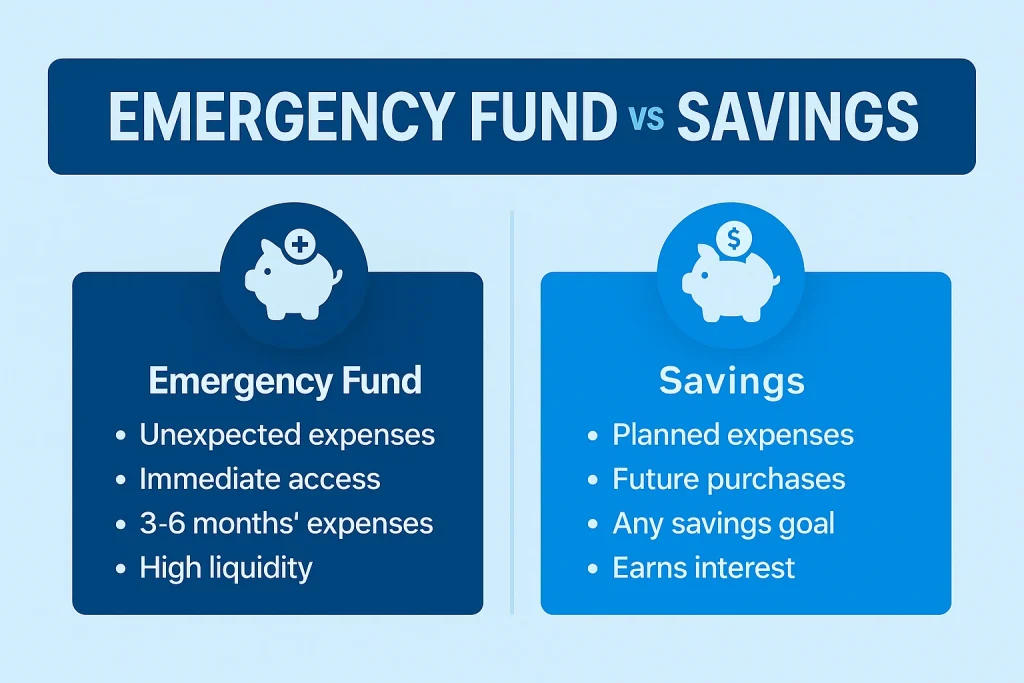
Emergency funds and general savings serve distinct financial purposes. An emergency fund acts as a financial safety net for unexpected expenses. General savings supports planned financial goals and purchases. Understanding this difference is crucial for effective financial management. This guide explores the vs comparison in detail. You will learn how to balance both financial tools effectively. Proper allocation provides security and enables goal achievement simultaneously.
Last updated September 2025 • Reading time 12 min
Quick Overview: Emergency Fund vs Savings
| Aspect | Emergency Fund | General Savings |
| Purpose | Unexpected emergencies | Planned goals & purchases |
| Recommended Amount | 3-6 months’ expenses | Varies by goal |
| Accessibility | Immediate access needed | Can be less liquid |
| Account Type | Savings or money market account | Various options |
| Priority Level | High priority before other goals | Secondary to emergency fund |

Why Understanding the Difference Matters
Emergency funds provide crucial financial protection against unexpected events. Only 44% of Americans could cover a $1,000 emergency from savings in 2024 8. This statistic highlights the importance of dedicated emergency preparedness. Without this protection, people often resort to high-interest debt options. Approximately 25% would charge unexpected expenses to credit cards 3.
General savings serve different financial purposes altogether. They fund planned goals like vacations, home purchases, or education. Separating these funds prevents accidental use of emergency resources. This separation maintains financial stability during unexpected circumstances. Proper allocation between both categories optimizes financial health 6.
Understanding the difference prevents financial stress during emergencies. It also ensures progress toward important life goals. This knowledge represents fundamental financial literacy. Implementation provides both security and opportunity simultaneously 9.
Detailed Comparison: Emergency Fund vs Savings
Purpose and Function
Emergency funds specifically cover unexpected financial emergencies. These include job loss, medical emergencies, or urgent car repairs. The fund acts as a financial safety net during crises. It prevents debt accumulation when unexpected expenses occur 1. This protection maintains financial stability during difficult times.
General savings serve planned financial goals and purchases. These include vacations, home down payments, or education funding. Savings also cover predictable irregular expenses like car maintenance. Separating these funds prevents emergency fund depletion for non-emergencies 6. This distinction maintains financial organization and goal progression.
The key difference lies in intentionality versus protection. Emergency funds protect against unforeseen circumstances. General savings enable intentional goal achievement. Both are essential but serve different financial functions 4.
Recommended Amounts
Emergency funds typically require 3-6 months’ living expenses. This amount provides adequate protection during job loss or major emergencies. The exact amount depends on individual circumstances and risk factors 7. Some experts recommend starting with $1,000 before building the full fund 7.
General savings amounts vary significantly based on specific goals. A vacation might require $3,000 while a home down payment needs much more. Each goal determines its own savings target amount 6. Regular contributions ensure steady progress toward these targets.
Calculation methods differ between both fund types. Emergency funds base calculations on essential monthly expenses. General savings base calculations on goal costs and timelines. This difference reflects their distinct purposes and usage scenarios 5.
Account Types and Accessibility
Emergency funds require highly accessible, liquid accounts. Savings accounts or money market accounts work best for this purpose. These accounts offer immediate access without penalties or market risk 8. FDIC insurance protects these funds up to $250,000 6.
General savings can utilize less accessible account options. Certificates of deposit (CDs) or investment accounts may be appropriate. These options often provide higher returns than standard savings accounts 5. The trade-off involves reduced accessibility and potential market risk.
Account selection significantly impacts fund effectiveness. Emergency funds prioritize accessibility over returns. General savings can prioritize growth over immediate accessibility 10. This distinction guides appropriate account selection for each purpose.
Priority and Funding Sequence
Emergency funds take priority over general savings goals. Financial experts recommend building emergency savings first 7. This approach provides protection before pursuing other financial objectives. Without this protection, unexpected events can derail financial progress.
General savings become appropriate after establishing emergency protection. Once the emergency fund is established, focus can shift to other goals 9. This sequence ensures financial stability during goal achievement.
Simultaneous funding approaches can also work effectively. Allocating most resources to emergency funding initially makes sense. Smaller contributions to general savings maintain motivation toward goals 4. This balanced approach addresses both protection and aspiration.
Comparison Table: Emergency Fund vs Savings
| Feature | Emergency Fund | General Savings |
| Primary Purpose | Unexpected financial emergencies | Planned purchases and goals |
| Recommended Amount | 3-6 months’ essential expenses | Goal-dependent amount |
| Account Type | Savings account, money market | Various options including CDs |
| Accessibility | Immediate access required | Can have limited accessibility |
| Risk Tolerance | Very low (no market risk) | Variable (depending on goal) |
| Funding Priority | High (before other savings) | Secondary (after emergency fund) |
| Interest Focus | Low interest acceptable | Higher interest desirable |
| Withdrawal Conditions | True emergencies only | Planned goal fulfillment |
How to Build Both Funds: Step-by-Step Guide
Step 1: Assess Your Current Financial Situation
Calculate your essential monthly expenses first. Include housing, utilities, groceries, and minimum debt payments. This calculation determines your emergency fund target amount 5. Next, identify your savings goals and their estimated costs. This assessment provides clarity on both fund requirements.
Step 2: Establish Budget Allocation
Implement the 50/30/20 budget rule as a starting point. Allocate 50% to needs, 30% to wants, and 20% to savings 6. Prioritize emergency fund contributions within the savings category. Adjust these percentages based on your specific financial situation.
Step 3: Choose Appropriate Accounts
Select a high-yield savings account for your emergency fund. Ensure it offers easy access without penalties 8. Choose different accounts for various savings goals based on timelines. Longer-term goals might benefit from investment accounts 5.
Step 4: Automate Contributions
Set up automatic transfers to both fund types. Schedule these transfers to occur immediately after paycheck deposits 2. Automation ensures consistent contributions without willpower requirement. This approach builds both funds gradually and consistently.
Step 5: Monitor and Adjust Regularly
Review both fund balances monthly during budget check-ins. Adjust contributions as your financial situation changes 10. Celebrate milestones to maintain motivation toward your targets. Regular monitoring ensures continued progress toward both objectives.
Step 6: Replenish After Use
Immediately resume contributions if you use emergency funds 8. Prioritize rebuilding this protection before other financial goals. This practice maintains your financial safety net continuously. The same principle applies to savings goals after withdrawals.
Frequently Asked Questions (FAQ)
Should I build emergency fund or savings first?
Build your emergency fund first before focusing on general savings. Financial experts recommend this sequence for financial security 7. Start with a $1,000 initial emergency fund goal. Then build toward 3-6 months’ expenses before other savings goals.
Can I use the same account for both purposes?
Separate accounts are strongly recommended for psychological and practical reasons. Physical separation prevents accidental use of emergency funds 9. Different accounts also help track progress toward specific goals. This separation maintains financial organization and discipline.
What counts as a true financial emergency?
True emergencies include job loss, medical emergencies, and essential repairs 4. These are unexpected, necessary expenses that threaten financial stability. Non-essential purchases like vacations don’t qualify as emergencies. Establish clear guidelines for what constitutes an emergency beforehand.
Where should I keep my emergency fund?
Keep emergency funds in highly accessible, low-risk accounts. FDIC-insured savings or money market accounts work best 8. Avoid investments with market risk or withdrawal penalties. Accessibility matters more than high returns for this specific fund.
How much should I have in general savings?
General savings amounts depend entirely on your specific goals. Calculate costs for each savings goal individually 6. Retirement savings have different targets than vacation savings. Each goal determines its own appropriate savings amount.
Can I invest my emergency fund for higher returns?
Avoid investing emergency funds in risky assets. The primary purpose is protection, not growth 8. Some options like high-yield savings accounts offer better returns safely. But preservation and accessibility remain the highest priorities.
What if I need to use my emergency fund?
Use your emergency fund when genuine emergencies occur without guilt 2. Then prioritize replenishing it before other financial goals. Resume automated contributions immediately after withdrawals. This practice maintains your financial safety net continuously.
Key Takeaways: Emergency Fund vs Savings
- Distinct purposes – Emergency funds protect against unexpected crises while savings enable planned goals
- Different amounts – Emergency funds need 3-6 months’ expenses; savings vary by goal
- Separate accounts – Maintain different accounts for each purpose to prevent confusion
- Accessibility matters – Emergency funds require immediate access; savings can be less liquid
- Funding priority – Build emergency protection before pursuing other savings goals
- Regular contributions – Automate contributions to both funds for consistent growth
Conclusion: Balancing Protection and Goals
Emergency funds and general saving serve complementary financial roles. Understanding their differences enables effective financial management. Both are essential components of comprehensive financial planning. Implementation provides both security and opportunity simultaneously.
Prioritize building your emergency fund before other financial goals. This approach provides crucial protection against unexpected events. Then focus on general savings for your specific goals and aspirations. This sequence ensures stability during goal achievement.
Remember that both funds require regular contributions and monitoring. Automated transfers make this process consistent and effortless. Regular reviews ensure your funds remain adequate for your changing circumstances. This maintenance keeps your financial plan effective long-term.
Author’s Note: As a certified financial planner with over 15 years of experience, I’ve witnessed how proper fund separation prevents financial crises. My recommendations are based on practical experience with countless clients and proven financial principles. Financial security comes from both protection and purposeful planning.
Reviewed by: Financial Education Department, Certified Financial Analysts
Recommended Reads & Tools
- “The Total Money Makeover” by Dave Ramsey – Classic guide to financial fitness and emergency fund building. Buy on Amazon
- “I Will Teach You to Be Rich” by Ramit Sethi – Practical system for conscious spending and savings automation. Buy on Amazon
- “Your Money or Your Life” by Vicki Robin – Transformative approach to values-based money management. Buy on Amazon
- Financial Peace Planner – Complete financial organization system with worksheets. Buy on Amazon
- Budgeting Workbook – Printable budget worksheets and savings trackers. Buy on Amazon
Further Learning
- Emergency Fund Basics – Complete guide to starting your emergency fund (YouTube)
- Savings vs Emergency Fund – Visual explanation of differences and strategies (YouTube)
Internal Linking Suggestions
- [Different Personal Budgeting Methods: Find Your Perfect System]
- [How to Create Your First Budget: Complete Beginner’s Guide]
- [Best Budgeting Tools for Beginners: 2025 Guide & Reviews]
- [Couples Financial Planning and Budgeting Guide]


